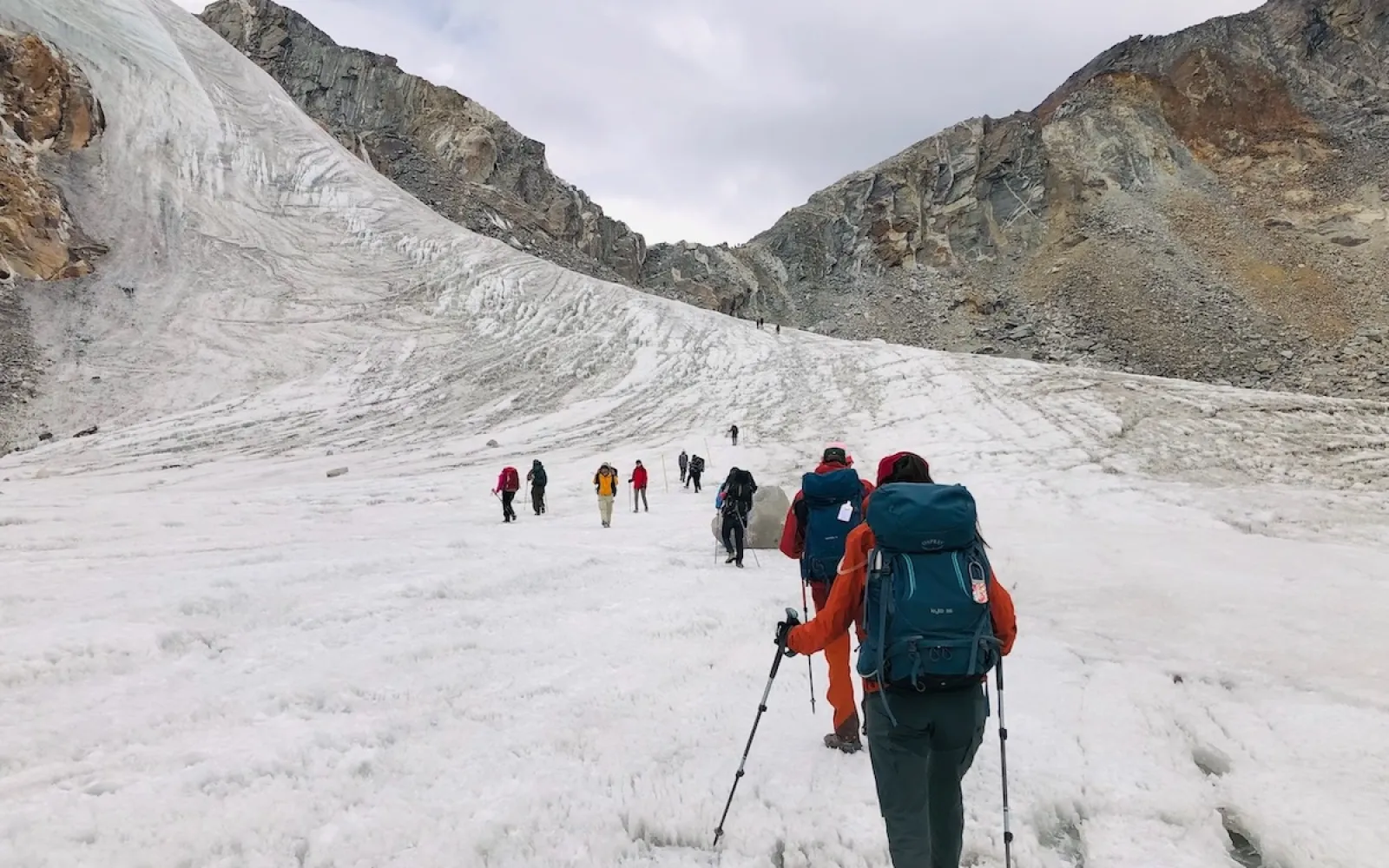
Everest Three Passes Trek is one of the most challenging and complete trekking adventures in Nepal’s Everest(Khumbu) region. This high-altitude journey crosses three major Himalayan passes of Khumbu valley —Khongma La (5,535 m), Cho La (5,420 m), and Renjo La (5,400 m), while visiting the famous and iconic destinations Everest Base Camp, Gokyo lakes & Gokyo Ri, Kala Patthar and Khumbu valley. This complete guide covers everything you need to know about the Everest Three Passes Trek itinerary, cost, permits, difficulties, best time, and proper preparation tips.
Three Passes trek of Everest region delivers the most comprehensive Himalayan experience, which takes 18-21 days walking 5-7 hours daily and 7-9 hours during crossing the passes. Trekkers do not just trek, they complete the spectacular circuit through the entire Khumbu region, ecploring remote Himalayan landscapes and view points that most trekkers of the classic Everest trekkers route never experience.
The Everest Three Passes Trek is more than a trek - it's one of the greatest trekking adventures in Nepal in Khumbu region.
Most trek descriptions romanticize the passes. Let me give you reality.
Elevation gain from Chhukung: 685 vertical meters Time to summit: 4-5 hours of brutal climbing Difficulty rating: High
This is typically your first pass, and it hits hard. You're leaving Chhukung (4,730m) in pre-dawn darkness, headlamps illuminating rocky moraine, lungs screaming for oxygen that isn't there.
The terrain: Loose scree, glacier debris, possible snow fields depending on season. No technical climbing, but the path isn't always obvious. Your guide will be looking for cairns (stone markers) showing the route.
The altitude factor: At 5,535m, you're higher than any point in Europe or North America. Every step requires focus and determination.
What makes it special: Khongma La is the least-traveled of the three passes. You might go the entire day seeing only your group. The views from the top—Makalu (5th highest peak in the world) dominating the eastern horizon, Ama Dablam's perfect pyramid to the south, and the entire Khumbu Glacier spread below—are worth every gasping breath.
Descent to Lobuche: Steep, rocky, hard on knees. Takes 2-3 hours. You'll arrive exhausted but victorious, having conquered the highest pass on the circuit.
Starting point: Dzongla (4,830m) Vertical gain: 590 meters Time to cross: 7-8 hours total (up and down) Difficulty rating: Very High (includes glacier crossing)
Cho La is what people fear most about this trek, and rightfully so. This isn't just walking uphill—there's actual glacier traversing involved.
The morning start: 5-6 AM departure. You need to cross before afternoon sun melts snow bridges and destabilizes ice. You'll be hiking in darkness for the first hour, which is eerie and beautiful and slightly terrifying.
The eastern approach (from Dzongla): Steep climbing through rocky terrain, then you hit the glacier section. Depending on season and conditions, you might need:
The summit ridge: Wind-blasted, often icy, with fixed ropes in the steepest section. Prayer flags whipping in the wind mark the high point. Views of Cholatse (6,440m) and Ama Dablam will take your breath away literally, because you're gasping at this altitude anyway.
The western descent (toward Gokyo): This side is actually more technical than the ascent. Steep, loose rock, some sections requiring hand-over-hand scrambling. Takes 3-4 hours to reach the bottom.
Starting elevation: Gokyo (4,790m)
Vertical gain: 570 meters Time to summit: 3-4 hours up, 2-3 hours down Difficulty rating: Moderate-High
By the time you reach Renjo La, you're a different trekker than who started this journey. Your body is altitude-adapted, your legs are stronger, and you know your capabilities.
The approach: Steep switchbacks climbing the western side of the Gokyo Valley. The gradient is relentless but the path is clear. You're gaining altitude quickly but the views keep you motivated.
The summit experience: This is where the Everest Three Passes Trek pays off spectacularly. From Renjo La's summit, you get The view—Everest, Lhotse, Nuptse, Makalu, Cho Oyu (6th highest peak), Gyachung Khang, and dozens more peaks creating an unbroken wall of Himalayan giants.
What makes Renjo La unique: Unlike Khongma La's remoteness or Cho La's technical challenge, Renjo La is about pure, overwhelming beauty. The Gokyo Lakes shimmer turquoise below you, the Ngozumpa Glacier (longest in the Himalayas) snakes through the valley, and that mountain panorama stretches 180 degrees.
Most descriptions focus on the passes, but the valleys between them hold equally incredible experiences:
After crossing Cho La, you descend into the Gokyo Valley—a landscape so beautiful it almost doesn't seem real.
Gokyo Lakes (Dudh Pokhari): Six glacial lakes, each a different shade of turquoise-green. The Nepali name "Dudh Pokhari" means "Milk Lakes" because of their distinctive color caused by glacial rock flour suspended in the water.
Sacred significance: These lakes are pilgrimage sites for both Hindus and Buddhists. During the Janai Purnima festival (August full moon), thousands of Hindu pilgrims make the journey here for ritual bathing. You'll see prayer flags and small shrines around each lake.
Gokyo Ri (5,357m): The viewpoint above Gokyo village offers what many consider the best Everest vista in the entire region. Unlike Kala Patthar where Everest is partially obscured, from Gokyo Ri you see Everest's full pyramid rising behind the Nuptse-Lhotse wall. The sunrise climb (2-3 hours) is mandatory. You haven't truly experienced Gokyo without watching dawn light hit Everest from this viewpoint.
Why Gokyo matters: While standard Everest Base Camp treks skip this entire valley, you're experiencing one of the Khumbu's most spectacular areas. The serenity here—glacial lakes, fewer trekkers, intimate lodges—provides a beautiful counterpoint to the more trafficked EBC trail.
Most trekkers rush through Chhukung on their way to Kongma La. That's a mistake.
Location: Chhukung sits at 4,730m in a side valley branching east from Dingboche. It's literally a handful of lodges in a massive amphitheater of peaks: Island Peak (6,189m), Lhotse (8,516m—4th highest in world), Nuptse (7,861m), and the massive south face of Ama Dablam.
Why experienced trekkers love Chhukung: It feels remote, almost exploratory. You're away from the main EBC trail traffic, surrounded by massive peaks, staying in basic but cozy lodges, and genuinely earning your views through difficult hiking.
After Renjo La, you descend to Thame (3,800m)—a village most EBC trekkers never see.
Historical significance: Thame is considered the ancestral home of many famous mountaineering Sherpas, including Tenzing Norgay's family (first person with Edmund Hillary to summit Everest in 1953). The village has produced more Everest summiters per capita than anywhere else in Nepal.
Connecting to wider exploration: From Thame, experienced trekkers can extend into the Rolwaling Valley or take alternative routes toward Tibet border areas (permits required). Most Three Passes trekkers just pass through, but it's worth lingering.
Let's have an honest conversation about fitness requirements.
Minimum baseline:
Preparation that actually works:
1-2 months before trek:
1 month before:
Optimal: October to early November
Why this is peak season:
The downside: Crowds. You'll share trails with hundreds of trekkers daily on main routes (though passes themselves are less crowded).
Excellent: Late March to April
Spring advantages:
Considerations: Cho La can still have significant snow in March. May gets hazy with pre-monsoon clouds building afternoons.
Possible but challenging: December to February
Winter realities:
Who does winter treks: Experienced mountaineers seeking solitude, photographers wanting crystal-clear skies, hardcore trekkers who've done this route before.
Avoid: June to September
Monsoon makes this trek miserable:
The Upper Mustang or Upper Dolpo treks work in monsoon (rain shadow areas), but Three Passes? Skip it.
Permits required:
Insurance non-negotiables:
Companies that properly cover Nepal high-altitude trekking: World Nomads, IMG Global, True Traveller, Battleface. Verify coverage specifically mentions "mountaineering/trekking above 5,000m."
Communication on trail:
Accommodation reality:
Choosing the right trekking company is essential for safe Everest Three Passes Trek. With over a decade of experience organizing Himalayan adventure since 2012, Higher Path Treks and Expedition provides professional service, experienced local guides, and well planned itinerary.
Our licensed Sherpa guides have extensive experience in the Everest region and are trained to handle high altitude trekking challenges, safety procedures, and emergency situations. our experienced support team ensures smooth logistics throughout the journey.
Every trek carries:
Our 20-22 day itinerary isn't arbitrarily long—it's based on proven acclimatization protocols:
We won't tell you this trek is easy if you're "reasonably fit." It's not. We won't promise perfect weather—it's the Himalayas. We won't guarantee you'll cross all three passes—weather and health determine that.
Our completion rate (crossing all three passes) runs around 85-90% during optimal seasons. The 10-15% who don't complete usually face weather closures (Cho La mainly) or altitude issues requiring early descent. No company honestly has higher completion rates—anyone claiming 95%+ is fudging numbers.
The Three Passes trek is the logical next step. You know the altitude challenges, you've experienced Khumbu culture, and you're ready for something more demanding. This trek shows you the Everest region's hidden sides—Gokyo Lakes, Chhukung Valley, remote high passes—that standard EBC misses entirely.
Not ready for three passes but want Gokyo Lakes? The Gokyo Valley Trek offers those stunning turquoise lakes and Gokyo Ri viewpoint without the extreme pass crossings. Great option for trekkers wanting beauty without technical difficulty.
After Three Passes, some trekkers extend to:
This trek is perfect if you:
Skip this trek if you:
Ready to test yourself against three of the Himalayas' most legendary passes?
Contact Higher Path Treks & Expeditions. Let's discuss whether you're ready, what preparation you need, and how we'll support you through this extraordinary adventure.
The passes are waiting. The question is: are you?