Need help with booking? Send us a message.
3*** Hotel in Kathmandu and Tea House / Lodge / Camp during the trek
Higher Path Treks & Expeditions proudly offers the unforgettable Mera Peak Budget Climbing adventure for trekkers and climbers seeking a cost-effective Himalayan expedition without compromising safety, professionalism, and authentic mountain experiences. Standing at 6,461 meters, Mera Peak is the highest trekking peak in Nepal and one of the most rewarding climbing destinations in the Everest region. This carefully designed budget itinerary combines scenic trekking, gradual acclimatization, technical climbing preparation, and breathtaking Himalayan panoramas, making it ideal for both beginner climbers and experienced trekkers looking to attempt their first Himalayan summit.
The journey begins in Kathmandu and follows the beautiful, less-crowded Hinku Valley route through remote Sherpa villages, dense rhododendron forests, alpine meadows, and glacier landscapes before reaching the summit. Throughout the expedition, climbers experience spectacular views of some of the world’s highest mountains including Mount Everest, Makalu, Lhotse, Cho Oyu, and Ama Dablam. The climb itself is considered non-technical compared to major Himalayan expeditions, yet it still provides the excitement of glacier travel, crampon walking, and high-altitude mountaineering.
This budget climbing package is specially created for adventure lovers who wish to explore the Himalayas at an affordable price while receiving reliable services from experienced local guides and climbing staff. The itinerary includes acclimatization days, climbing training, transportation arrangements, tea house accommodation, and essential logistical support required for a successful summit attempt. Safety remains the highest priority throughout the expedition, and the experienced team from Higher Path Treks & Expeditions continuously monitors trekkers’ health, altitude adaptation, and weather conditions.
Seasonal Rates
Choosing the right season is extremely important for a successful and enjoyable Mera Peak Budget Climbing expedition. The best times for climbing Mera Peak are during the spring season (March to May) and the autumn season (September to November). These periods provide the most stable weather conditions, clear mountain views, safer climbing conditions, and comfortable trekking temperatures throughout the Everest region. During these months, trekkers can enjoy excellent visibility, lower chances of heavy snowfall, and safer glacier crossings.
Spring is one of the most popular climbing seasons because the weather gradually becomes warmer after winter. Rhododendron forests bloom beautifully along the lower trekking trails, creating colorful landscapes throughout the Hinku Valley. The skies are usually clear in the mornings, allowing spectacular sunrise and mountain views. Temperatures remain moderate at lower elevations, while higher regions around Khare and High Camp stay cold but manageable for climbers. Spring also offers stable snow conditions on the summit route, making climbing safer for beginners.
Autumn is another outstanding season for Mera Peak climbing. After the monsoon rains, the atmosphere becomes exceptionally clear, producing crystal-clear Himalayan panoramas and fresh mountain air. Trails are dry, weather conditions are stable, and visibility is often at its best during this season. Autumn temperatures are slightly colder than spring at higher altitudes, but the stable weather makes it ideal for summit attempts. This season is highly recommended for photographers and trekkers who want uninterrupted mountain scenery.
Winter climbing between December and February is possible but more challenging due to freezing temperatures, strong winds, and heavy snowfall at high elevations. Similarly, the summer monsoon season from June to August brings frequent rain, slippery trails, cloud-covered mountains, and flight delays, making it less favorable for trekking and climbing activities.
Best Seasons at a Glance
Mera Peak is considered a moderately challenging Himalayan climbing expedition. Although it is categorized as a trekking peak, climbers still need good physical fitness, endurance, and strong determination to successfully reach the summit. The biggest challenge is not technical climbing difficulty but rather the high altitude, long trekking days, freezing temperatures, and changing mountain weather conditions. Climbers must walk for several consecutive days through rugged terrain before reaching elevations above 6,000 meters.
The climbing route involves glacier travel, snow slopes, and the use of mountaineering equipment such as crampons, ice axes, harnesses, ropes, and ascenders. However, no advanced technical climbing experience is necessary because the climbing guides from Higher Path Treks & Expeditions provide pre-climb training at Khare before the summit attempt. Beginners with strong trekking experience and proper preparation can successfully complete the climb with guidance from professional climbing staff. Acclimatization days are carefully included in the itinerary to reduce the risk of altitude sickness and improve summit success rates.
Transportation for the expedition includes both road travel and mountain flights. The journey starts with a scenic drive from Kathmandu to Manthali in the Ramechhap district, followed by an early morning flight to Lukla. Due to increasing air traffic in Kathmandu, many Lukla flights now operate from Ramechhap during peak trekking seasons. The short mountain flight to Lukla offers incredible aerial views of the Himalayas and serves as the gateway to the Everest region.
After completing the climb, trekkers retrace the route back to Lukla before flying again to Manthali and driving back to Kathmandu. Weather conditions in the Himalayas can sometimes affect flight schedules, so the itinerary includes a reserve contingency day to handle possible delays safely and comfortably.
Difficulty and Transportation Highlights
During the Mera Peak Budget Climbing expedition, trekkers are provided with simple but comfortable accommodation and nutritious meals throughout the journey. In lower and middle trekking regions, accommodation is mainly arranged in traditional tea houses operated by local Sherpa families. These tea houses offer twin-sharing rooms with basic bedding facilities, warm dining halls, and friendly hospitality. As the trek progresses toward higher elevations, accommodation becomes more basic due to the remoteness of the region. At Mera High Camp, climbers stay in tented camps prepared by the expedition crew because permanent lodges are unavailable at such high altitude.
Meals during the trek are designed to provide enough energy for long trekking days and high-altitude climbing. Tea houses along the route serve a variety of local Nepali, Tibetan, and international dishes including dal bhat, fried rice, noodles, soup, potatoes, bread, eggs, porridge, pasta, pancakes, and hot drinks. Dal bhat is particularly popular among trekkers because it provides excellent nutrition and unlimited refills in many tea houses. As altitude increases, food variety becomes more limited due to transportation difficulties, but guides ensure trekkers receive sufficient calories and hydration.
At High Camp, the climbing crew prepares warm meals and hot drinks to help climbers conserve energy before summit day. Proper hydration is strongly encouraged throughout the expedition because drinking enough water is essential for altitude adaptation and overall health. While luxury facilities are limited in remote mountain regions, the authentic tea house experience allows trekkers to connect closely with local culture and Himalayan hospitality.
Higher Path Treks & Expeditions carefully selects accommodations and meal arrangements to ensure safety, cleanliness, and comfort while maintaining affordability for budget-conscious climbers.
Food and Accommodation Features
Climbing Mera Peak requires several official permits issued by the Nepalese government and local authorities. These permits are mandatory for all trekkers and climbers entering the Everest and Hinku Valley regions. Higher Path Treks & Expeditions manages all necessary permit arrangements on behalf of climbers, allowing participants to focus fully on preparation and the climbing experience itself.
The most important document is the Mera Peak Climbing Permit, issued by the Nepal Mountaineering Association (NMA). Permit costs vary depending on the climbing season, with spring generally being the most expensive due to higher demand. In addition to the climbing permit, trekkers also require the Makalu Barun National Park Permit and the Khumbu Pasang Lhamu Rural Municipality Permit. These permits help support conservation efforts, trail maintenance, environmental protection, and local community development within the Himalayan region.
Trekkers must also carry valid passports, passport-sized photographs, and travel insurance covering high-altitude trekking and emergency helicopter evacuation. Comprehensive travel insurance is extremely important because medical evacuation costs in remote Himalayan regions can be very expensive. Climbers are advised to check their insurance policies carefully before arriving in Nepal to ensure sufficient altitude coverage for climbing above 6,000 meters.
Permit regulations may occasionally change according to government policies, so working with an experienced local company such as Higher Path Treks & Expeditions helps ensure smooth permit processing and updated travel information.
Required Permits for Mera Peak
Choosing Mera Peak Budget Climbing with Higher Path Treks & Expeditions offers adventure seekers the perfect combination of affordability, safety, professionalism, and authentic Himalayan experiences. This expedition is carefully designed for trekkers who want to achieve a Himalayan summit without the extremely high costs associated with major mountaineering expeditions. Despite being a budget package, the company maintains high standards of service, experienced guiding staff, proper acclimatization schedules, and reliable logistical support throughout the journey.
One of the biggest advantages of this expedition is the remote and peaceful trekking route through the Hinku Valley. Unlike the crowded Everest Base Camp trail, this region offers quiet mountain landscapes, traditional Sherpa culture, untouched forests, and genuine wilderness experiences. Climbers can fully enjoy the beauty of the Himalayas while avoiding heavy trekking traffic. The summit itself provides one of the finest panoramic mountain views in Nepal, including five of the world’s highest peaks visible from the top.
Higher Path Treks & Expeditions prioritizes client safety above all else. Experienced climbing guides provide technical training, altitude monitoring, weather assessments, and emergency support throughout the expedition. The itinerary also includes proper acclimatization and contingency days to maximize safety and summit success rates. Whether you are an experienced trekker or attempting your first Himalayan climb, the supportive team ensures a well-organized and memorable adventure from arrival to departure.
This expedition is more than simply reaching a summit. It is an opportunity to experience Himalayan culture, test personal limits, build confidence, and create lifelong memories in one of the world’s most spectacular mountain regions.
Reasons to Choose This Expedition
Notes
Mera Peak is located in the Everest region and requires good physical fitness and a positive mindset for high-altitude trekking and peak climbing.
Optional Upgrade
Kathmandu – Lukla – Kathmandu Helicopter Service
For greater comfort and to avoid possible flight delays, direct helicopter flights are available at an additional cost of USD 600 per person (one way).
Upon your arrival at Tribhuvan International Airport in Kathmandu, a representative from Higher Path Treks & Expeditions will warmly welcome you and transfer you to your hotel in the heart of the city. After checking into your comfortable 3-star accommodation, you can relax and recover from your international journey. In the evening, there will be a trek briefing where your guide will explain the complete itinerary, safety procedures, altitude precautions, and climbing preparation for Mera Peak. You may also use this time to explore nearby markets such as Thamel, where you can buy or rent any last-minute trekking and climbing gear before the adventure officially begins.
Today you have a relaxed morning in Kathmandu before beginning the scenic drive toward Manthali in the Ramechhap district. After breakfast and final packing preparations, you will depart in a shared jeep arranged by Higher Path Treks & Expeditions. The drive takes several hours through winding mountain roads, charming villages, terraced farmlands, and riverside scenery. This journey allows trekkers to experience the rural beauty of Nepal before entering the Everest region. Upon arrival in Manthali, you will settle into a local guesthouse and rest early because the Lukla flight the next morning usually departs very early. Your guide will once again confirm flight timings and trekking preparations.
Early in the morning, you will board a thrilling mountain flight from Ramechhap to Lukla, one of the world’s most exciting air routes. The spectacular flight offers incredible aerial views of Himalayan landscapes before landing at Lukla Airport. After meeting the porters and organizing trekking gear, the journey officially begins. The trail descends gradually through forests, suspension bridges, and small Sherpa settlements before reaching Paiya, also known as Chutok. Along the route, you will enjoy views of green hills, waterfalls, and traditional mountain life. The peaceful environment of Paiya provides a perfect first overnight stop while allowing your body to gradually adjust to increasing altitude.
After breakfast, the trail continues through dense rhododendron and bamboo forests before descending toward a small river crossing. The route then climbs steadily uphill toward the village of Panggom. Today’s trek is moderately challenging because of several steep ascents and descents along narrow mountain paths. However, the beautiful scenery and quiet atmosphere make the journey highly rewarding. As you walk through remote villages and cultivated farmland, you will experience authentic Himalayan culture away from the busier Everest Base Camp trails. Upon reaching Panggom, you can relax in a traditional tea house and enjoy the hospitality of local Sherpa families while surrounded by beautiful mountain landscapes.
Today’s trail begins with a gradual climb through forests covered with rhododendron, pine, and mossy trees. The route passes several ridges and traditional settlements before entering more remote terrain. As the altitude slowly increases, the surrounding scenery becomes increasingly dramatic with distant Himalayan views appearing throughout the day. The trek eventually reaches Ramailo Danda, which literally means “beautiful hill.” True to its name, this scenic location offers magnificent panoramic views and a peaceful environment ideal for acclimatization. During the evening, your guide from Higher Path Treks & Expeditions will monitor your health and ensure you are adapting well to the altitude.
The trail today takes you deeper into the remote Hinku Valley region. You will descend through forested trails and cross several streams before reaching the beautiful Chhetra Khola area. The route involves multiple ascents and descents, making it physically demanding but very scenic. Along the way, you may encounter local yak herders and seasonal grazing areas used by mountain communities. The peaceful riverside campsite at Chhetra Khola provides a tranquil overnight stop surrounded by forests and mountain wilderness. This less-traveled route allows trekkers to experience the untouched beauty of Nepal’s eastern Himalayas while avoiding crowded trekking routes commonly found in other Everest region trails.
Today’s trek follows the Hinku River upstream through dense forests filled with pine and rhododendron trees. The trail gradually climbs higher into alpine terrain, and the air becomes cooler as you gain elevation. You may spot wildlife such as mountain birds and Himalayan goats along the way. As the valley opens, stunning views of Mera Peak and surrounding snow-covered mountains begin to appear for the first time. Reaching Kothe feels like entering a true Himalayan wilderness. This beautiful settlement lies beside the river and serves as an important resting point for climbers heading toward Mera Peak. After dinner, your guide will discuss altitude awareness and hydration for the higher days ahead.
Leaving Kothe behind, the trail continues along the Hinku Valley with increasingly spectacular mountain scenery. Today’s route follows rocky paths beside the river while passing ancient yak grazing pastures and seasonal herding camps. As you gain altitude, vegetation becomes sparse and the landscape transforms into a rugged alpine environment. Along the way, magnificent views of Kusum Kanguru, Mera Peak, and other towering Himalayan giants dominate the skyline. After several hours of trekking, you will reach Thangnak, a small settlement surrounded by glacial moraine and dramatic mountain scenery. Due to the higher altitude, the pace remains slow and steady to help with proper acclimatization and energy conservation.
Today’s journey is shorter but more physically demanding because of the altitude. The trail gradually ascends across glacial terrain and rocky landscapes while offering breathtaking views of towering snow peaks. As you approach Khare, the atmosphere becomes distinctly alpine with glaciers, icy ridges, and expansive mountain panoramas surrounding the area. Khare is the main climbing base for Mera Peak expeditions and serves as an important acclimatization point before the summit push. Upon arrival, your climbing guide will inspect your equipment and provide detailed information about glacier travel, climbing techniques, and summit procedures. The rest of the day is reserved for rest, hydration, and preparation for the upcoming high-altitude climb.
This important acclimatization day helps your body adjust to the altitude while preparing you for the technical aspects of the climb. After breakfast, your experienced climbing guide from Higher Path Treks & Expeditions will conduct practical training sessions on nearby snow slopes and glacier sections. You will learn how to use crampons, harnesses, ice axes, ropes, ascenders, and other essential climbing equipment. The guide will also teach basic glacier safety, walking techniques, and rope management skills necessary for summit day. In the afternoon, you can rest and enjoy magnificent views of the surrounding Himalayan peaks while mentally and physically preparing for the challenging days ahead.
Today marks the beginning of the climbing phase of the expedition. After an early breakfast, you will ascend gradually toward Mera High Camp by crossing the Mera Glacier. The route involves walking on snow and ice while using crampons under the supervision of your climbing guide. As you climb higher, the views become absolutely breathtaking with Everest, Makalu, Lhotse, and Cho Oyu appearing prominently across the Himalayan skyline. After several hours of careful ascent, you will reach High Camp, located on a rocky ridge with incredible panoramic scenery. The expedition team will set up tents and prepare warm meals while you rest and prepare for the midnight summit attempt.
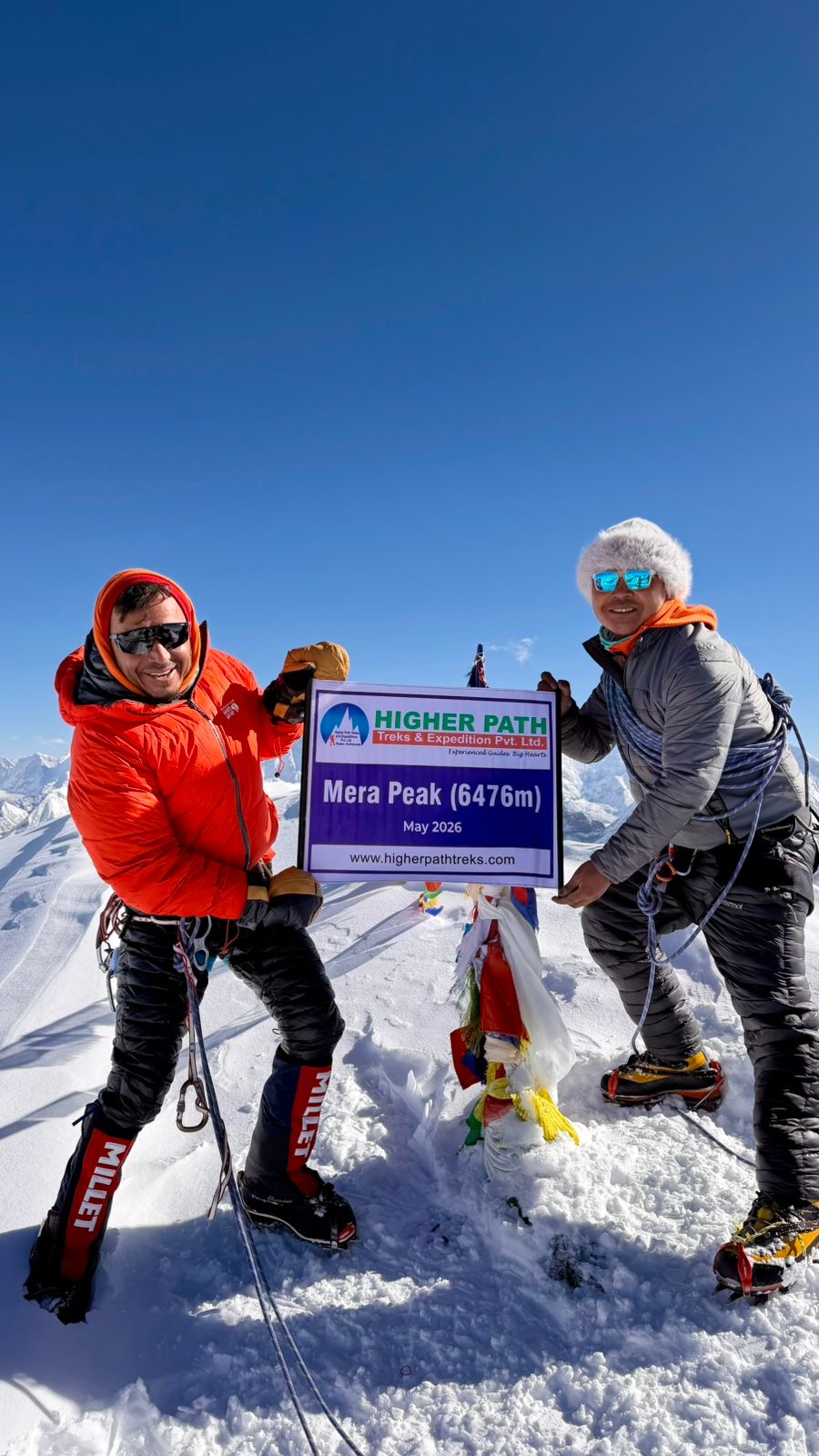
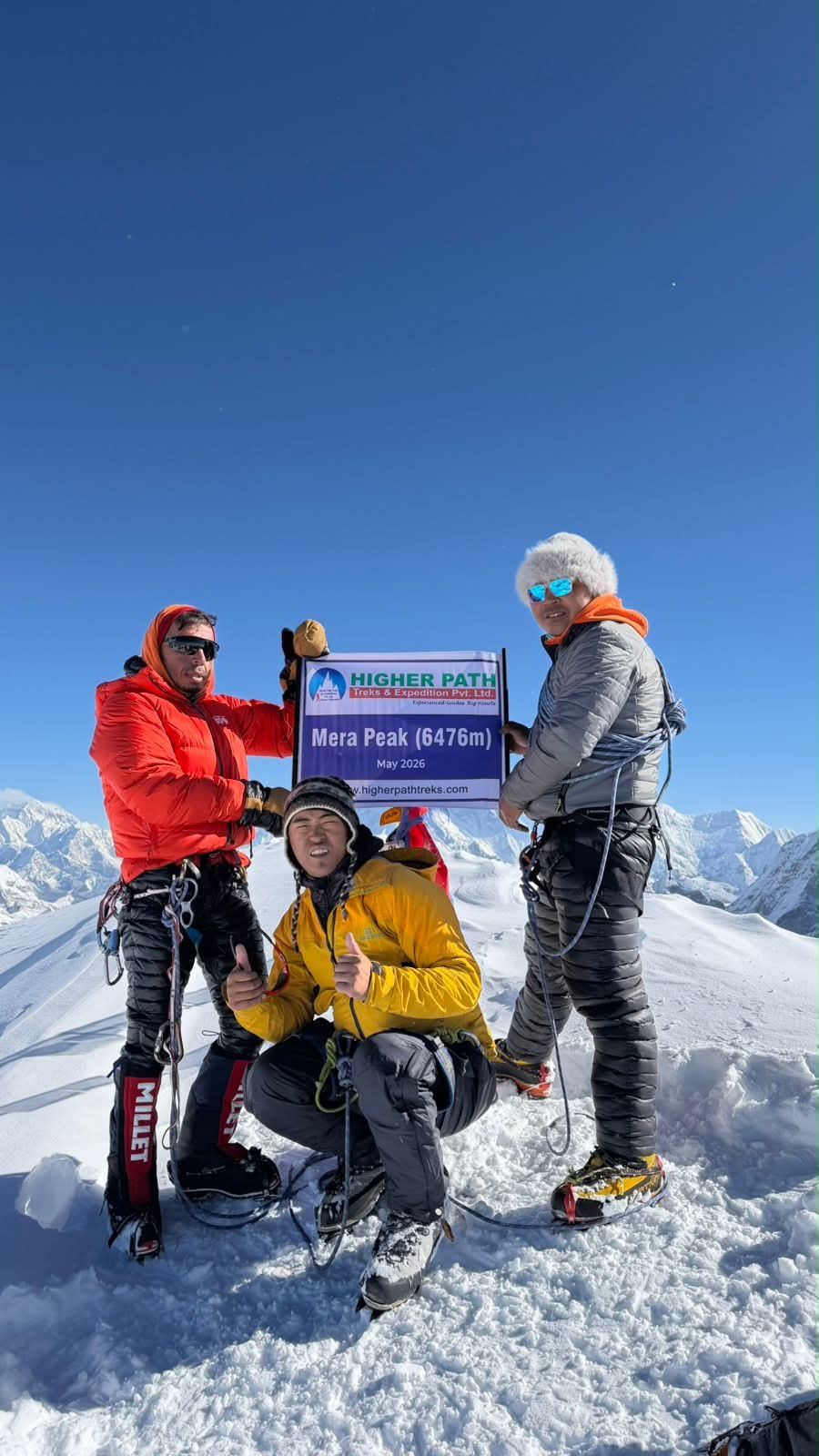
Today is the most challenging and rewarding day of the entire expedition. Around 2 am, you will begin the summit push under the guidance of experienced climbing staff from Higher Path Treks & Expeditions. Moving slowly across glaciers and snowy slopes, you will climb steadily toward the summit as the first rays of sunlight illuminate the Himalayas. Upon reaching the summit of Mera Peak (6,461 m), you will witness one of the finest mountain panoramas in Nepal, including Everest, Lhotse, Makalu, Cho Oyu, and Ama Dablam. After celebrating this unforgettable achievement and capturing photographs, you will carefully descend back to High Camp before continuing down to Khare for a well-deserved rest and overnight stay.
This extra day is reserved as a contingency in case of bad weather, delayed flights, or unexpected climbing conditions. In the Himalayas, weather can change rapidly, especially at high altitude, so having an additional day greatly increases the chances of a successful summit. If the summit was completed as planned, this day can be used for additional rest and recovery in Khare or nearby areas. Your guide will carefully assess weather forecasts and team conditions before making any decisions. This reserve day demonstrates the importance of safety and flexibility during Himalayan climbing expeditions and helps ensure a smoother overall experience for all participants.
After the demanding summit experience, today’s trek is mostly downhill as you retrace your route back through the beautiful Hinku Valley. Descending to lower altitude brings noticeable relief and increased energy levels after several days spent above 5,000 meters. The return journey offers another opportunity to enjoy the dramatic mountain scenery, glacial landscapes, and peaceful alpine environment. Passing through Thangnak and alongside the river, you will eventually arrive at Kothe for an overnight stay. The warmer temperatures and thicker air make the evening especially comfortable. You can relax with fellow climbers, celebrate your successful summit, and reflect on the incredible achievement of climbing Mera Peak.
Today’s trek continues downhill through forests, river valleys, and remote mountain trails as you gradually leave the higher alpine region behind. The trail passes through peaceful landscapes filled with rhododendron forests, waterfalls, and traditional yak grazing areas. As you descend further, the environment becomes greener and more vibrant once again. The route to Chetara includes several ups and downs, making it a moderately long trekking day despite the overall descent. Along the way, you can interact with local villagers and observe traditional Himalayan lifestyles that remain largely unchanged for generations. Overnight accommodation will be arranged at a simple tea house or campsite depending on local availability.
The final trekking day of the expedition takes you back toward Lukla through beautiful forests and traditional Sherpa villages. The trail gradually reconnects with the more popular Everest trekking routes, bringing a lively atmosphere after several days in remote wilderness. As you approach Lukla, you may feel a strong sense of accomplishment reflecting on the entire Mera Peak adventure. Upon arrival, there is time to rest, enjoy a hot meal, and celebrate with your trekking crew. Many trekkers choose to thank their guides and porters during the farewell evening. This final night in the mountains provides a memorable conclusion to an incredible Himalayan climbing journey.
Early in the morning, you will take a scenic return flight from Lukla to Ramechhap. Weather permitting, the short mountain flight once again offers spectacular aerial views of the Himalayas and deep valleys below. Upon landing in Manthali, a shared jeep arranged by Higher Path Treks & Expeditions will transfer you back to Kathmandu. After arriving in the city, you can finally enjoy a comfortable hotel stay, hot shower, and proper rest after the expedition. The evening is free for shopping, sightseeing, or celebrating your successful Mera Peak climb with your team members and guide.
Today marks the end of your unforgettable Mera Peak Budget Climbing adventure with Higher Path Treks & Expeditions. Depending on your international flight schedule, the company representative will transfer you to Tribhuvan International Airport for your final departure. As you leave Nepal, you will carry incredible memories of high Himalayan landscapes, Sherpa culture, glacier trekking, and the remarkable achievement of standing atop Mera Peak at 6,461 meters. The experience not only offers physical accomplishment but also a deep connection with the beauty and spirit of the Himalayas.
Your Start Date is the day you land in Nepal, and your End Date is when you fly home.
If the set Mera Peak Budget Climbing group dates don’t suit your schedule, we can offer alternative dates upon request.
An amazing value-for-money climbing experience with Higher Path Treks & Expeditions. The Mera Peak budget package was well arranged, making high-altitude climbing accessible without compromising safety or guidance. The itinerary was smooth, and the team handled logistics, permits, and accommodation very efficiently. Our guide was experienced and always focused on acclimatization and safety, which made a big difference at higher elevations. The views from the Mera region were absolutely breathtaking, offering a true Himalayan wilderness feel. A perfect choice for climbers looking for an affordable yet authentic expedition experience in Nepal.
A fantastic and well-managed adventure with Higher Path Treks & Expeditions. The Mera Peak budget climbing package offered excellent organization at an affordable cost, without compromising safety or support. The guides were attentive, especially during acclimatization days, and made sure everyone was comfortable and prepared for high altitude conditions. The journey through remote valleys and glaciers felt truly wild and rewarding. Reaching the region near Mera Peak was an unforgettable experience, with stunning panoramic views of the Himalayas. Highly recommended for budget-conscious climbers seeking a real Himalayan expedition.
Yes, Mera Peak Budget Climbing is considered one of the best introductory climbing adventures in Nepal for trekkers who want to experience Himalayan mountaineering for the first time. Although Mera Peak reaches an impressive altitude of 6,461 meters, the technical climbing difficulty is relatively moderate compared to other trekking peaks in Nepal. However, participants should still have good physical fitness, strong determination, and previous trekking experience at high altitude. Higher Path Treks & Expeditions provides experienced climbing guides who offer pre-climb training and full support throughout the expedition, making it achievable even for first-time climbers with proper preparation and acclimatization.
The Mera Peak Budget Climbing package offered by Higher Path Treks & Expeditions includes most of the essential services required for a safe and organized expedition. The package generally covers hotel accommodation in Kathmandu with breakfast, shared jeep transfer to Ramechhap, domestic flights between Ramechhap and Lukla, trekking permits, Mera Peak climbing permit, tea house accommodation during the trek, three meals per day during trekking, porter services, experienced English-speaking guides, high camp tent accommodation, and full-board meals during the climbing phase. However, personal climbing gear, travel insurance, drinks, Wi-Fi, charging facilities, tips, and personal expenses are usually excluded from the package cost.
Mera Peak is categorized as a trekking peak, which means it is less technical than major mountaineering expeditions such as Everest or Ama Dablam. However, climbers should not underestimate the challenge because the high altitude itself makes the expedition physically demanding. The summit push involves glacier walking, snow slopes, and the use of basic climbing equipment such as crampons, harnesses, ropes, and ice axes. The biggest challenge is often altitude and endurance rather than technical climbing. With the professional guidance and acclimatization schedule arranged by Higher Path Treks & Expeditions, climbers are given enough preparation time to safely attempt the summit.
Previous technical climbing experience is helpful but not mandatory for Mera Peak. Many climbers successfully summit Mera Peak as their first Himalayan climbing experience. What is more important is having good physical conditioning, mental determination, and some prior trekking experience at higher altitudes. Before the summit attempt, guides from Higher Path Treks & Expeditions provide practical training sessions in Khare where climbers learn to use climbing equipment, walk on glaciers, and follow rope techniques. These training sessions are designed to build confidence and prepare climbers for summit day even if they have never used mountaineering gear before.
Higher Path Treks & Expeditions is committed to providing safe, affordable, and professionally organized Himalayan adventures for trekkers and climbers from around the world. The company focuses on experienced local guides, personalized service, proper acclimatization schedules, and strong safety management throughout the expedition. Their Mera Peak Budget Climbing package is designed to offer excellent value while maintaining quality service and support. From airport arrival to final departure, the team assists clients with permits, transportation, accommodation, meals, climbing logistics, and emergency coordination. Their knowledgeable guides and friendly staff help create a memorable and successful Himalayan climbing experience for every participant.
The best seasons for Mera Peak Budget Climbing are spring (March to May) and autumn (September to November). During these periods, the weather in the Everest region is generally more stable, skies remain clearer, and mountain views are spectacular. Spring offers blooming rhododendron forests and warmer temperatures, while autumn provides crisp mountain air and excellent visibility after the monsoon season. Winter climbs are possible but extremely cold, especially at high camp and summit sections. Monsoon season is generally less favorable because of heavy rain, cloudy conditions, and difficult trail conditions. Higher Path Treks & Expeditions carefully schedules climbs during the safest and most favorable weather windows.
During the trekking portion of the expedition, accommodation is mainly provided in traditional tea houses with twin-sharing rooms and basic mountain facilities. In remote areas, rooms are simple but comfortable enough for trekkers to rest after long walking days. At High Camp, tent accommodation is provided because there are no permanent lodges available at that altitude. Meals during the trek usually include breakfast, lunch, and dinner with a variety of local and international dishes such as rice, noodles, soup, potatoes, pasta, eggs, and bread. Higher Path Treks & Expeditions ensures that climbers receive nutritious meals to maintain energy and proper acclimatization throughout the journey.
Mera Peak stands at an elevation of 6,461 meters, making it the highest trekking peak in Nepal. One of the greatest highlights of climbing Mera Peak is the extraordinary panoramic view from the summit. Climbers can witness five of the world’s highest mountains, including Everest, Lhotse, Makalu, Cho Oyu, and Kangchenjunga on clear days. In addition to these giant Himalayan peaks, other stunning mountains such as Ama Dablam and Baruntse also dominate the surrounding skyline. Higher Path Treks & Expeditions organizes summit attempts during favorable weather conditions to maximize the chances of enjoying these breathtaking mountain views safely.
Yes, altitude sickness is one of the primary concerns during Mera Peak climbing because the expedition reaches elevations above 6,000 meters. Even physically fit trekkers can experience altitude-related symptoms if proper acclimatization is ignored. Common symptoms may include headache, nausea, fatigue, dizziness, and shortness of breath. To reduce risks, Higher Path Treks & Expeditions follows a carefully designed itinerary with gradual altitude gain and acclimatization days built into the schedule. Guides continuously monitor climbers’ health conditions and provide advice regarding hydration, pacing, nutrition, and rest. In severe situations, immediate descent remains the most effective treatment for altitude sickness.
Climbers need proper trekking and climbing equipment to ensure safety and comfort during the expedition. Essential personal gear includes warm down jackets, thermal clothing, waterproof outer layers, trekking boots, gloves, sleeping bags, sunglasses, and headlamps. For the climbing section, equipment such as crampons, harnesses, mountaineering boots, helmets, and ice axes are required. Many trekkers choose to rent climbing gear in Kathmandu before departure. Higher Path Treks & Expeditions can assist climbers with gear recommendations, equipment checks, and rental arrangements to ensure all participants are adequately prepared for high-altitude conditions and glacier travel.