
Annapurna Base Camp Trek
| Trip code | |
| Package name | Annapurna Base Camp Trek |
| Duration | 13 |
| Max. elevation | 4130 m |
| Level | moderate |
| Transportation | All ground transportation (Bus) as per itinerary |
| Accomodation | |
| Starts at | Kathmandu |
| Ends at | Kathmandu |
| Trip route | <p>Kathmandu-Pokhara-Chhomrung_Bamboo-Deurali-Macchhapuchhre Basecamp-Annapurna Basecamp-Bamboo-Jhino Danda-Pokhara-Kathmandu</p> |
Highlights
- Enjoy stunning views of Annapurna I, Annapurna South, Machhapuchhre (Fishtail), and other peaks from the base camp.
- Encounter diverse ethnic communities along the trail, including Gurungs and Magars, with opportunities to experience their traditions and hospitality.
- Trek through lush rhododendron forests, terraced fields, and serene valleys with the backdrop of snow-capped peaks.
- Relax in natural hot springs at Jhinu Danda, perfect for soothing tired muscles after days of trekking.
- Explore the Annapurna Sanctuary within the Annapurna Conservation Area, known for its rich biodiversity and protected wildlife.
- Suitable for trekkers of various fitness levels, offering a moderate trekking challenge with gradual ascents.
- Visit Machhapuchhre Base Camp en route to Annapurna Base Camp, another scenic viewpoint with close-up views of Machhapuchhre.
- Visit traditional villages like Chhomrong and Bamboo, experiencing local culture and traditions firsthand.
- Witness a mesmerizing sunrise over the Himalayas from Annapurna Base Camp, a highlight of the trek.
Overview
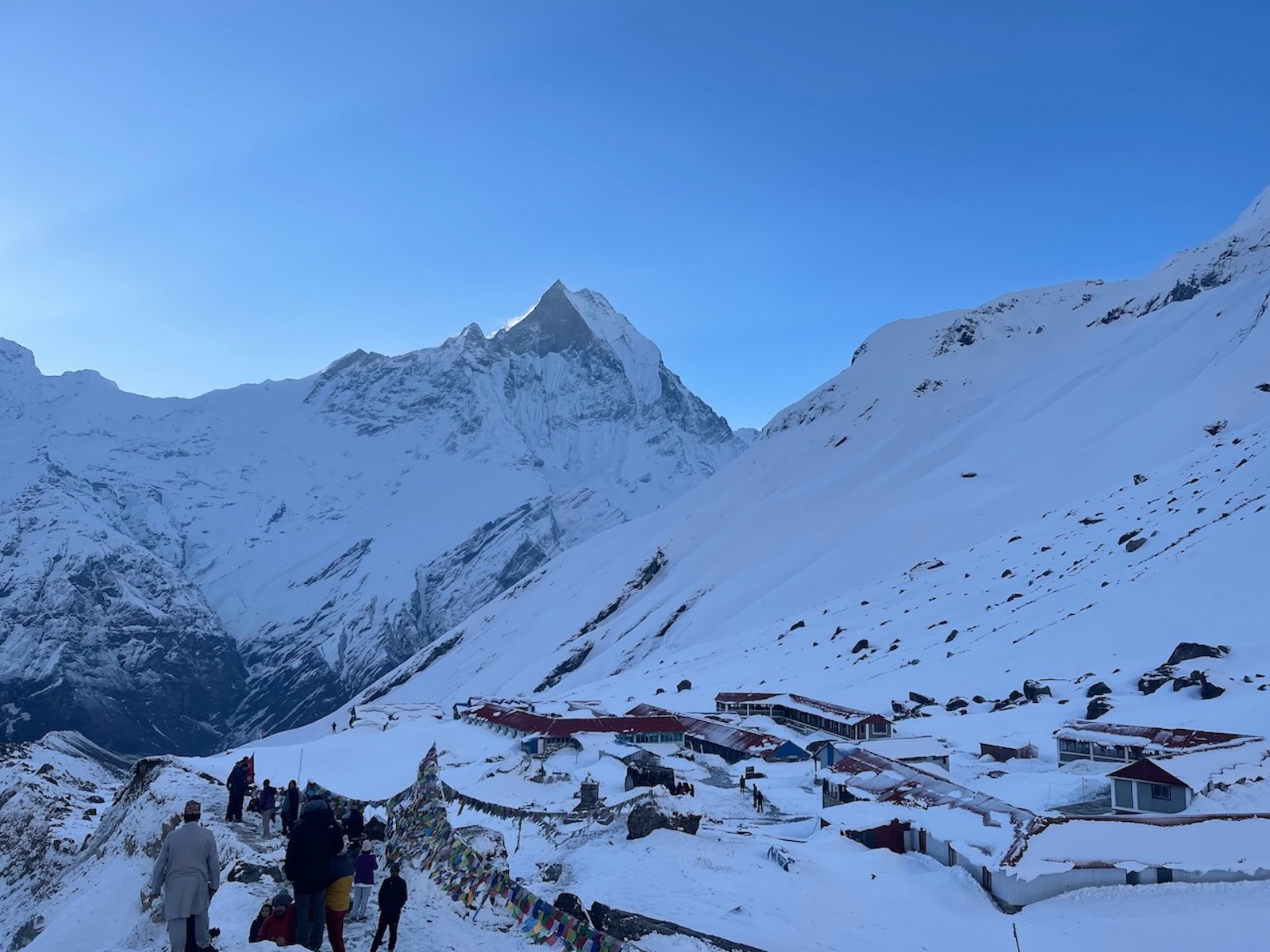
The Annapurna Base Camp Trek is one of most popular trek in Nepal, taking you through rhododendron forests that explode with color in spring, passing through traditional Gurung villages where life moves at mountain pace, and watching the landscape transform from subtropical valleys to alpine glaciers over the course of a week. This 7-9 days trek offers breathtaking views of Mt.Annapurna, Fishtail, Hiunchuli and surrounding peaks. Standing at 4,130 meters with a 360-degree panorama of some of the world's highest peaks surrounding you—that's what awaits at Annapurna Base Camp.
The Annapurna Base Camp trek has earned its place as one of Nepal's most popular routes for good reason. It's accessible enough for fit beginners with proper preparation, yet spectacular enough to satisfy experienced trekkers. You don't need technical climbing skills or oxygen tanks. Just good fitness, determination, and the right support team.
That's where Higher Path Treks comes in. We've been guiding trekkers to Annapurna Base Camp for years, and we've learned what actually matters on this journey—not just getting you there, but making sure the experience exceeds whatever expectations you arrived with.
Quick Facts
- Duration: 13 days
- Maximum Altitude: 4130 m
- Destination: Annapurna Base Camp
- Difficulty: Moderate
- Best Season: Spring (March-May) and autumn (September- November)
- Accommodation: Teahouse during the trek
- Meal: Breakfast, lunch and dinner during the trek
- Start/End Point: Kathmandu
Why Choose Annapurna Base Camp Trek
Let's talk honestly about why ABC stands out among Nepal's many trekking options.
Accessibility without compromise: The trek typically takes 7-12 days depending on your route and pace.That's shorter than treks like Everest Base Camp or the Annapurna Circuit, making it doable for people with limited vacation time. But shorter doesn't mean less impressive—the mountain views rival anything Nepal offers.
Diverse landscapes in compact distance: You start in subtropical valleys around Pokhara where it's warm enough for banana trees. Within days, you're in alpine zones surrounded by glaciers and 7,000+ meter peaks. Few treks pack this much landscape variety into one journey.
Cultural immersion: The trail passes through Gurung and Magar villages where traditional Himalayan culture thrives. You're not just walking past villages—you're staying in them, eating with families, and experiencing daily mountain life firsthand.
The amphitheater effect: ABC sits in a natural sanctuary completely surrounded by massive peaks. Annapurna I (8,091m), Annapurna South (7,219m), Hiunchuli (6,441m), and the sacred Machhapuchhre (6,993m) form walls around you. Watching sunrise hit these peaks from base camp is genuinely one of trekking's great moments.
Well-established infrastructure: The ABC trail has proper teahouses, clear paths, and reliable facilities. You're trekking in wilderness, but you're not roughing it compared with more remote Himalayan routes ABC trek offers excellent infrastructures.
Reaching Annapurna Base Camp at 4130 m
The final push from MBC to Annapurna Base Camp (4,130m) takes 2-3 hours.The trail climbs gradually through increasingly barren terrain.When you crest the final rise and ABC opens before you, it hits different than you expect.
You're standing in a natural sanctuary—a massive cirque completely surrounded by 7,000 and 8,000-meter peaks.Annapurna I, the 10th highest mountain in the world, rises directly before you.Annapurna South, Hiunchuli, and Gangapurna complete the amphitheater.It's not just seeing mountains—it's being inside them.
Sunrise at ABC is what everyone talks about.The first light hits the peaks, slowly painting them gold while the valley remains in blue shadow.It's cold (often below freezing), you're tired, and you probably didn't sleep great at 4,130m.But watching those mountains come alive makes every difficult moment worth it.
Best Time for Annapurna Base Camp Trek
Timing your ABC trek significantly impacts your experience.
Spring (March to May) - Prime Season
Spring is peak season for good reason. March through May offers stable weather, clear skies, and the famous rhododendron blooms.
March can still be cold at ABC with possible snow, but lower sections are beautiful with flowers starting to bloom. April is probably the single best month—warm enough to be comfortable, flowers in full bloom, excellent visibility. May gets warmer (sometimes too warm in lower sections), but it's still good trekking before monsoon arrives.
Advantages: Best weather reliability. Rhododendron forests at their most spectacular. Clear mountain views.Comfortable temperatures.
Autumn (September to November) - Also Excellent
After monsoon clears in September, autumn brings the year's clearest skies and stable weather.
September can still have occasional monsoon tail-end rain, but by late September conditions stabilize. October offers perfect trekking weather—comfortable temperatures, crystal-clear visibility, stable conditions. November gets colder, especially at ABC where morning temperatures drop well below freezing, but it's still excellent for trekking.
Advantages: Clearest mountain views of the year. Post-monsoon clarity makes distant peaks incredibly visible. Stable, predictable weather. Comfortable temperatures for walking.
Winter (December to February) - Possible but Challenging
Winter trekking to ABC is doable but requires proper preparation. Temperatures at base camp drop to -10°C to -20°C. Snow is likely, sometimes heavy. Some higher teahouses might close if snow gets too deep. The trail can be icy and slippery.
That said, winter offers unique rewards: total solitude, pristine snow-covered landscapes, the clearest skies of the year. Just be prepared with proper gear, flexible schedule, and acceptance that reaching ABC might not be possible if conditions are extreme.
Monsoon (June to August) - Generally Avoid
Monsoon makes ABC trekking less enjoyable. Heavy rain, leeches on the lower trail, clouds obscuring views, and increased landslide risk. The trails become muddy and slippery. However, the Annapurna region is in the rain shadow to some extent, meaning it gets less monsoon impact than areas like the Everest region, some adventurous trekkers still go, accepting reduced visibility for extreme solitude.
Annapurna Base Camp Trek Difficulty
The Annapurna Base Camp trek is classified as moderate to challenging, but let's break down what that actually means.
Altitude: You reach 4,130m at ABC. Altitude sickness is possible and must be taken seriously. Proper acclimatization matters—don't rush the ascent. Most itineraries build in gradual altitude gain, but you still need to monitor symptoms and descend if problems develop.
Daily walking time: Typically 5-7 hours per day. Some days are easier (3-4 hours), some are longer (7-8 hours). The walking itself isn't technical, just sustained effort with altitude making things harder.
Terrain: Well-maintained trails with some steep sections.You'll climb thousands of stone steps (Nepali "staircases"), cross suspension bridges, and navigate rocky paths. Trekking poles help significantly.
Fitness requirements: You should be comfortable walking 5-6 hours daily for a week. Prior trekking experience helps but isn't mandatory. We've successfully guided everyone from college students to retirees—fitness and determination matter more than age.
Technical skills: None required. This is walking, not climbing. No ropes, no technical equipment beyond normal trekking gear.
Accommodation and Food on the Trail
Let's be realistic about what "teahouse trekking" means.
Lower Section Lodges (Nayapul to Chhomrong)
These villages have well-established tourism, so lodges are comfortable. Private or semi-private rooms with beds (foam mattresses), clean blankets, and communal bathrooms. Hot showers usually available for extra fee.Dining rooms have menus offering surprising variety—Dal Bhat, pasta, breakfast options.
The food in lower sections is fresh—vegetables from local farms, decent quality, well-prepared. You won't go hungry or eat poorly.
Middle Section (Bamboo to Himalaya Hotel)
Lodges get more basic but remain comfortable enough.Rooms are simple—beds with blankets, shared bathrooms.Hot water becomes less reliable (sometimes bucket washes only). Food options narrow somewhat—Dal Bhat becomes more prominent, though other choices exist.
Upper Section (Deurali to ABC)
At altitude, lodges are genuinely basic. Small rooms, thin mattresses, limited blankets (your sleeping bag matters here), shared pit toilets (yes, really). Hot showers? Not happening. You'll use wet wipes or bucket washes.
Food menus shrink significantly. Dal Bhat is the most economical option (usually includes unlimited refills). Other dishes are available but more expensive because everything must be carried up or flown in by helicopter.
At ABC itself, the lodge is about survival more than comfort. It's cold (below freezing), facilities are minimal, and food is simple. But you're sleeping at 4,130m in one of the world's most spectacular mountain amphitheaters. The location makes up for amenities.
What to Expect Each Day
Let's talk about what daily life on the ABC trek actually looks like.
Morning starts early—usually around 6-7 AM. Lodges serve breakfast (porridge, eggs, Tibetan bread, tea/coffee). You pack your daypack (the porter carries your main bag), and start walking by 7:30-8 AM.
Morning walking is typically 2-3 hours before a tea break. You'll stop at a teahouse for tea, maybe a snack. These breaks are social—talking with your guide, meeting other trekkers, enjoying the mountain views.
Midday walking continues another 2-3 hours until you reach that day's destination, usually by early afternoon (1-3 PM). This timing is intentional—afternoon weather is less predictable in the mountains, and arriving early gives time to rest before weather potentially deteriorates.
Afternoons are yours—explore the village, read, write in your journal, play cards with other trekkers, or just sit and stare at mountains. The pace is relaxed once walking finishes.
Dinner happens around 6-7 PM. Dal bhat (rice and lentils) is the staple, though menus offer other options like fried rice, noodles, pizza (surprisingly decent in lower villages), and momos (dumplings). Food is simple but filling and nutritious.
Evenings are communal. Lodges have dining rooms with central stoves (or fireplaces lower down) where everyone gathers. You'll swap stories with other trekkers, play cards, plan the next day with your guide. Lights-out happens early—usually by 9-10 PM. You're tired from walking, and tomorrow brings another day of trekking.
Health and Safety Considerations
Your safety is our priority. Here's what you need to know.
Altitude Sickness
This is the main health concern at ABC. Acute Mountain Sickness (AMS) can affect anyone regardless of fitness. Common symptoms include headache, nausea, dizziness, fatigue, and sleep difficulty.
Prevention: Ascend gradually (our itineraries follow this principle), stay hydrated (3-4 liters daily), avoid alcohol, and recognize symptoms early.
Treatment: If symptoms are mild, rest at current altitude. If symptoms worsen or don't improve, descend immediately. Descent is the only reliable treatment for serious altitude sickness.
Your guide monitors everyone daily and knows when symptoms are normal adjustment versus dangerous problems. Trust their judgment—they've seen altitude sickness countless times.
Travel Insurance
You must have comprehensive travel insurance covering:
- Emergency evacuation by helicopter (ABC is at 4,130m)
- Medical treatment for altitude illness
- Trip cancellation/interruption
- Lost or stolen belongings
Water and Food Safety
Drink only purified water.Lodges sell bottled water (though we encourage using purification tablets or filters to reduce plastic waste). Never drink from streams or taps.
Food safety is generally good on the ABC trail. Lodges prepare food fresh, and turnover is high enough that nothing sits around getting old. Still, be cautious with raw vegetables in higher sections and stick to well-cooked foods.
What Makes This Trek Unforgettable
After guiding hundreds of trekkers to ABC, we've noticed patterns in what people remember most.
The amphitheater moment: That first view of ABC's complete mountain cirque—everyone remembers where they were when it opened before them.
Sunrise at base camp: Shivering in the freezing pre-dawn cold, waiting for first light to hit Annapurna's summit.
Rhododendron forests: If you trek in spring, walking through hillsides covered in blooming flowers feels magical.
Local hospitality: Lodge owners welcoming you with smiles and hot tea after a long day's walk. Conversations around the dining room stove. Kids waving from village doorways.
Physical accomplishment: Reaching 4,130m using only your own two feet. The sense of achievement is real and earned.
Mountain solitude: Despite being a popular trek, moments of solitude exist—sunrise at a viewpoint, a quiet trail section, evenings at your lodge watching peaks change color.
Simplicity: Days without internet, news, or daily stress. Just walking, eating, sleeping, repeat. Many trekkers describe it as meditative—a mental reset as valuable as the physical journey.
Why Trek with Higher Path Treks
Choosing the right trekking company matters, especially for your first Himalayan trek. Here's what sets Higher Path Treks apart:
Experienced Local Guides
Our guides aren't just leading you up trails—they're sharing their mountains with you. Most grew up in the Annapurna region or nearby areas. They know every village, every viewpoint, every section of trail. More importantly, they understand altitude sickness, weather patterns, and when to adjust plans for safety.
They're certified by the Nepal government with training in first aid, altitude illness recognition, and rescue procedures. But beyond certifications, they're good people who genuinely care about your experience.
Proper Acclimatization Schedules
Our itineraries follow proper altitude gain principles—ascending gradually, building in acclimatization stops, and maintaining flexibility to adjust if someone's struggling. Your guide monitors everyone's condition daily.
Quality Accommodation Selection
Get comfortable teahouse, which offer the best combination of cleanliness, food quality, and hospitality at each stop.
In lower sections, you'll stay in comfortable lodges with hot showers (for a small fee), decent beds, and good food. Higher up, facilities become more basic, but we choose the best available options. At ABC, accommodations are simple, but you're sleeping at 4,130 m surrounded by 8,000-meter peaks—the location makes up for basic amenities.
Safety and Communication
Safety isn't something we compromise on. All guides carry comprehensive first aid kits and are trained to handle emergencies. We carry communication equipment for emergencies and have established relationships with helicopter rescue companies.
Weather delays flights? Unexpected storm? Someone needs extra acclimatization? We adjust plans as needed. Flexibility is built into our approach because mountains don't follow schedules.
Cultural Sensitivity and Sustainable Tourism
We're committed to responsible tourism. That means:
- Employing local guides and porters, keeping tourism money in mountain communities
- Following strict leave-no-trace principles
- Supporting local lodges and businesses along the trail
- Educating trekkers about cultural respect and environmental protection
- Contributing to community development projects in the region
When you trek with us, you're supporting sustainable tourism that benefits local people, not just taking from their homeland.
Ready to Trek to Annapurna Base Camp?
The Annapurna Base Camp Trek is more than just reaching a destination. It's walking through some of Nepal's most beautiful landscapes. It's experiencing traditional mountain culture firsthand. It's pushing your physical limits at altitude. It's sunrise over 8,000-meter peaks and evenings around lodge fireplaces sharing stories with fellow trekkers.
The mountains will be there whenever you're ready. But there's something special about committing to a date, buying the plane ticket, and actually going. Plans made are plans that might happen. Tickets bought are adventures that will.
Higher Path Treks & Expedition, will handle the logistics, provide experienced guides, ensure your safety, and support you every step from Kathmandu to ABC and back.
The Annapurna range is waiting. When you're ready, we'll take you there.
Helpful Blogs About Trekking in the Annapurna Region:
Uncover the best blogs about trekking in the Annapurna region, featuring expert advice, detailed itineraries, personal experiences, and essential tips for adventurers looking to explore the Himalayas.
Annapurna Base Camp Trek: A Short Journey to the Himalayas
Annapurna Circuit Trek with Tilicho Lake – A Complete Guide by Higher Path Treks & Expeditions
Top Tips for Climbing Pisang Peak on the Annapurna Circuit
Top Reasons to Trek Ghorepani Poon Hill
Top Reasons to Choose Tilicho Lake Trek with Thorong La Pass
Best Experience on the Short Mardi Himal Trek: A Journey to Remember
Top Reasons to Combine Pisang Peak Climbing with the Annapurna Circuit Trek
Comparing Chulu Far East Peak Climbing vs Chulu West Peak Climbing
The most picturesque village Ghandruk
Photography Guide: Capturing the Himalayas Without Expensive Gear
Nepal Peak Climbing 2026: Routes, Tips, and Top Summits
The Best Hiking Adventures: Famous Peak Climbs in 2025
Top Himalayan Peaks for Beginner Climbers: A Comprehensive Guide
Is Peak Climbing in Nepal Easy for Beginners?
Top Best Expedition Packages in Nepal 2025
Experience Mountain View in Nepal
Top Highlights of the Annapurna Base Camp Trek
Trip Preparation
Trip Itinerary
Day 1 : Arrival in Kathmandu
Welcome to Nepal! When you land at Tribhuvan International Airport, our team will be waiting with a warm greeting and your name on a sign. We'll transfer you to your hotel in Thamel, Kathmandu's vibrant tourist district. After checking in and freshening up, the rest of the day is yours to recover from jet lag or explore if you're feeling energetic.
Thamel's narrow streets are packed with trekking shops, restaurants serving everything from dal bhat to pizza, and colorful markets. It's the perfect introduction to Kathmandu's organized chaos. This evening, we'll meet for a trek briefing where your guide will explain the route, answer questions, and check your gear. It's also a great chance to meet any other trekkers joining your group. Rest well tonight—tomorrow brings cultural exploration before the mountain adventure begins.
Day 2 : Sightseeing Tour in Kathmandu
Today's dedicated to experiencing Kathmandu's incredible cultural heritage. After breakfast, we'll visit several UNESCO World Heritage Sites that showcase Nepal's rich history and spirituality.
First stop is Swayambhunath, the famous Monkey Temple perched on a hilltop with panoramic city views and resident monkeys who think they own the place. Then we'll visit Pashupatinath Temple on the Bagmati River's banks, where you'll witness Hindu cremation ceremonies and spiritual rituals. Next is Boudhanath Stupa, one of the world's largest Buddhist stupas where Tibetan pilgrims circumambulate while spinning prayer wheels. We'll also explore Kathmandu Durbar Square with its ancient palaces and intricate temple architecture.
After sightseeing, you'll have time for any last-minute shopping—picking up snacks, checking gear, or just relaxing. Tonight, double-check your trek pack and get good rest. Tomorrow we drive to Pokhara, gateway to the Annapurna region.
Day 3 : Drive from Kathmandu to Pokhara
After early breakfast, we'll hit the road for the scenic 6-hour drive to Pokhara. The journey follows the Prithvi Highway, winding through hills, terraced farmlands, and traditional villages. You'll see rural Nepal in action—people working fields, kids walking to school, daily mountain life happening alongside the road.
We'll stop for lunch at a highway restaurant (the food's surprisingly good), giving you a break to stretch your legs. As you approach Pokhara, the landscape opens up with views of Phewa Lake and, on clear days, the Annapurna range reflected in its waters.
Once in Pokhara, you'll check into your lakeside hotel. The rest of the afternoon is free—walk along the lake, grab coffee at a rooftop cafe, or just relax and prepare mentally for the trek starting tomorrow. Pokhara's vibe is much more relaxed than Kathmandu. Enjoy it while you can—tomorrow the trekking begins.
Day 4 : Drive from Pokhara to Ghandruk Village
The adventure officially starts today! After breakfast, we drive about 2 hours to Nayapul, the trek's starting point. The drive takes you out of Pokhara into foothill country where the mountains start feeling closer.
From Nayapul, your feet start moving. The trail climbs gradually through terraced rice fields and small settlements, ascending toward Ghandruk at 1,940m. You're walking through subtropical forests with occasional glimpses of Annapurna South and Machhapuchhre (Fishtail Mountain) peeking through trees.
After about 4 hours of trekking, you'll reach Ghandruk, a large traditional Gurung village with stone houses, slate roofs, and mountain views. Take time to explore—visit the Gurung Museum if it's open, walk the village's stone-paved streets, and watch locals going about their daily lives. Your lodge tonight offers comfortable beds and hot meals. The trek has begun, and you're officially in the mountains now.
Day 5 : Trek from Ghandruk to Chomrong
Today's a proper trekking day—about 6 hours with ups and downs through beautiful terrain. Leaving Ghandruk, the trail descends through rhododendron and oak forests (if you're trekking in spring, these forests bloom spectacularly). You'll cross suspension bridges over rushing rivers and pass through the small settlement of Kimrong.
Then comes the climb to Chhomrong, a major village built on steep hillsides at 2,170m. The final ascent involves lots of stone steps—Nepal's famous "staircases" that make your legs burn. But reaching Chhomrong brings stunning views of Annapurna South and Machhapuchhre rising directly above you.
Chhomrong is where you really feel like you've entered serious mountain territory. The village is substantial with multiple lodges, shops, and friendly locals used to trekkers passing through. Your lodge tonight offers decent comfort before things get more basic higher up. Rest those legs—tomorrow descends steeply before climbing again.
Day 6 : Trek from Chomrong to Dovan via Bamboo
Six hours of varied terrain today. The trail drops steeply from Chhomrong down to the Chhomrong Khola river (all those steps you climbed yesterday? You're going back down them). After crossing the river, the trail ascends through increasingly dense forest.
You'll pass through Sinuwa and Bamboo (named for the bamboo groves surrounding it)—small settlements with basic teahouses. The forest here is lush and green, with the Modi Khola river rushing alongside the trail. The valley narrows as you go deeper into the gorge.
Dovan (literally "two trees") sits at 2,600m in thick forest. It's small—maybe 3-4 lodges total—but peaceful. You're properly in the mountains now, following the river upstream toward Annapurna Sanctuary. The accommodation tonight is basic but clean. The forest atmosphere is special—quiet except for the river and occasional bird calls. Tomorrow continues climbing deeper into the valley.
Day 7 : Trek from Dovan to Machhapuchhre Base Camp
Today you climb significantly—from 2,600m to 3,700m at Machhapuchhre Base Camp. About 6 hours of ascending through changing landscapes. The forest gradually thins as you gain altitude, and mountain views start opening up.
You'll pass Himalaya Hotel (despite the name, it's a basic lodge) and Deurali where tree line ends and you enter alpine zone. The landscape transforms to rocky moraines with sparse vegetation. Suddenly, Machhapuchhre (Fishtail Mountain) dominates the view ahead—its distinctive twin peaks looking impossibly steep.
Machhapuchhre Base Camp (MBC) sits at 3,700m in a natural amphitheater with spectacular peak views. You're surrounded by giants now—Hiunchuli, Annapurna South, and of course Machhapuchhre looming above. The lodge here is basic (thin mattresses, shared bathrooms, cold temperatures), but the location is incredible. Tomorrow brings the final push to Annapurna Base Camp itself. Rest well and stay hydrated at this altitude.
Day 8 : Trek from Machhapuchhre Base Camp to Annapurna Base Camp
This is the day you've been working toward! The final push from MBC to Annapurna Base Camp takes about 4 hours—not long, but you're above 4,000m where every step requires more effort.
The trail climbs gradually through increasingly barren terrain. Moraine, rocky paths, maybe some snow patches depending on season. Prayer flags flutter in the constant wind. Then you crest the final rise, and Annapurna Base Camp opens before you.
You're standing in a massive natural sanctuary—a complete amphitheater of peaks surrounding you on all sides. Annapurna I (8,091m), the 10th highest mountain on Earth, rises directly ahead. Annapurna South, Hiunchuli, Gangapurna—giants everywhere you look. It's not just seeing mountains, it's being inside them.
Tonight's accommodation is the most basic yet—cold, simple, high altitude—but you're sleeping at 4,130m in one of the world's most spectacular locations. Set your alarm early. Sunrise tomorrow is what everyone talks about.
Day 9 : Trek from Annapurna Base Camp to Bamboo
Wake up before dawn (yes, it's freezing and you'd rather stay in your sleeping bag). But trust us—sunrise at ABC is worth it. Watch first light hit Annapurna's summit, slowly painting the peaks gold while the valley remains in blue shadow. It's magical, even half-frozen.
After breakfast and soaking in the views one last time, you begin descending. The drop from 4,130m to 2,310m is significant—about 6 hours of downhill through familiar terrain. You'll retrace yesterday's route through MBC and Dovan, then continue descending to Bamboo.
Going downhill is easier on your lungs but harder on your knees—trekking poles earn their keep today. By the time you reach Bamboo, you're back in the forest zone where it's warmer and you can breathe normally again. The lodge tonight feels almost luxurious after ABC's extreme basics. Your body will appreciate the lower altitude for sleeping.
Day 10 : Trek from Bamboo to Jhinu Danda
Six hours of continued descent today, dropping to Jhinu Danda at 1,780m. The trail climbs back up through Sinuwa and past Chhomrong (those steps again!), then descends steeply to Jhinu Danda.
Here's the reward: Jhinu Danda has natural hot springs! After a week of trekking and minimal washing (let's be honest, everyone's pretty grimy by now), soaking in natural hot water feels incredible. The springs are about a 15-minute walk down from the village—totally worth it.
The hot springs aren't fancy—natural pools by the river—but they're genuinely hot and perfect for sore muscles. Bring a towel and enjoy. This is your celebration spot, unofficial end-of-trek reward before tomorrow's final walk out to Nayapul.
The lodge tonight offers decent comfort. You're back at low altitude where food options improve and temperatures are pleasant. Enjoy your last night sleeping in mountain lodges—tomorrow returns you to roads and vehicles.
Day 11 : Short Trek and Drive to Pokhara
Final trekking day! After a relaxing morning at Jhinu Danda, you'll trek about 3-4 hours downhill to Nayapul. The trail descends through terraced fields and small villages, gradually leaving the mountains behind. You'll catch final glimpses of the Annapurna range in the distance—a last look at where you've been.
Reaching Nayapul marks the trek's official end. Your feet can finally rest! We'll meet our vehicle here and drive back to Pokhara (about 2 hours). The drive retraces your outbound route through foothill country.
Once in Pokhara, check into your lakeside hotel and celebrate however you want—hot shower that actually has pressure! Clean clothes! Restaurant with a menu! Beer that's cold! Internet! Many trekkers head to lakeside restaurants for burgers and beers (dal bhat gets old after a week).
Tonight, enjoy Pokhara's comforts. You completed the Annapurna Base Camp trek. That's a real accomplishment worth celebrating properly.
Day 12 : Drive from Pokhara to Kathmandu
After breakfast and maybe a final walk along Phewa Lake, we'll drive back to Kathmandu—about 6 hours retracing the Prithvi Highway. The journey gives you time to process the past week, watch rural Nepal pass by the windows, and transition back toward regular life.
We'll stop for lunch along the way at a highway restaurant. By now, this route feels familiar—you've done it twice, bookending your mountain adventure.
Arriving back in Kathmandu probably feels surreal. The city's chaos, traffic, noise—everything seems amplified after quiet mountain days. Check into your hotel and the rest of the day is yours. Many trekkers hit Thamel for last-minute shopping (gifts for home, maybe a new trekking jacket you decided you need). Others just rest and recover before flights home.
Tonight is your last in Nepal. Make it count—good dinner, maybe a rooftop bar overlooking the city, reminiscing with your trekking companions about the journey you shared.
Day 13 : Final Departure
Last morning in Nepal. Depending on your flight time, you might have a few hours for final activities—one more walk through Thamel, breakfast at your favorite spot, last-minute souvenir shopping.
Our representative will transfer you to Tribhuvan International Airport about 3 hours before your international flight (Kathmandu traffic is unpredictable, so we build in buffer time). At the airport, you'll probably see other trekkers heading home too—there's usually a quiet nod of recognition between people who've just spent time in the mountains.
As you fly out, look for mountain views from the plane window. On clear days, you can see the entire Himalayan range stretching across the horizon—including Annapurna, which you now know intimately from multiple angles.
Thank you for choosing Higher Path Treks for your Annapurna Base Camp adventure. We hope the memories you're carrying home stay with you forever. Safe travels, and who knows—maybe we'll see you back in Nepal for another trek someday!
Inclusions
What is included?
- Airport transportation (pick-up and drop-off)
- 2 nights accommodation in a 4-star hotel in Kathmandu / Pokhara with breakfast
- Tea house accommodations during the trek
- Kathmandu–Pokhara Round Trip Bus Service
- All meals (breakfast, lunch, dinner) during the trek
- All ground transportation as per the itinerary in a comfortable private vehicle
- English-speaking trained and experienced trekking guide
- Porter service (1 porter for 2 clients)
- Staff costs including salary, and insurance
- All necessary paperwork and trekking permits
- All government and local taxes
What isn't included?
- Personal trekking equipment (e.g., sleeping bag, trekking poles)
- Personal expenses such as cold drinks and alcohol during the trek
- Hot showers and charging facilities for electronic devices during the trek
- Internet usage fees and battery charging costs during the trek
- Meals during your stay in Kathmandu (apart from breakfasts included in the hotel)
- Tips for guide and porter
- Any additional expenses not mentioned in the "Included" section